Translate

Tuesday, April 29, 2014

Sundaram BNP Paribas Home Finance to raise Rs 3,800 cr

Chennai: Sundaram BNP Paribas Home Finance has proposed to raise Rs 3,800 crore during this financial
year through a mix of term loans, non-convertible debentures and refinancing from National Housing Bank, a top official said.

The company which would look at foraying into builder financing by end of this financial year, would also look at
ECB route to its fund raising plans, Sundaram BNP Paribas Home Finance Managing Director Srinivas Acharya said, a media report said.

Sundaram Home Finance will raise Rs 3,800 crore this year through a mix of term loans, NCDs, refinancing from NHB. The company could look at ECB route to fund raising but this would depend on the exchange rate fluctuation, he told PTI.

For the year ending March 31, 2014, Sundaram BNP Paribas Finance registered net profit at Rs 151 crore, up by 19 per cent from Rs 126 crore registered during the same period of previous year.

Overall disbursements of the company slipped to Rs 2,493 crore for the period ending March 31, 2014 from Rs 2,572 crore registered during the same period of previous year, he said.

Some loan disbursements,which is the core business of the company, grew by 13 per cent to Rs 1,740 crore compared to Rs 1,543 crore registered during the same period of previous year.

However, non-housing loan disbursements which include financing against mortgaged house properties slipped by 27 per cent to Rs 753 crore from Rs 1,029 crore registered during the same period of previous year.

Net NPA of the company stood at 0.46 per cent for the year ending March 31, 2014 as against 0.23 per cent registered during the same period of previous year.

The company has declared a dividend of 40 per cent for the year ending March 31, 2014.
"It has been quite a challenging year for us. The overall slowdown in the economy reflected in the lower demand in real estate space," Acharya said.

On the outlook for the current financial year, he said "We expect some revival in the economy over the next two
quarters and real estate sector should see an uptick in demand during the second half of this year," he said.
He said the company plans to open 20 new branches this year in Gujarat and Rajasthan.

Celebrate the beginning of Utsav Lavasa


Lavasa: It was a day to remember for over 400 senior citizens from Delhi, NCR, Bhiwadi, Jaipur, Pune, Lavasa and Mumbai, who got together on the behest of Ashiana Housing to mark the beginning of handing over of homes to the owners of Utsav Lavasa, a senior living project by the developer.

 To make the occasion more colourful and vibrant, house owners of similar projects of Ashiana in other cities were also invited for a grand get-together and provided them with an opportunity to share their experiences and expectations post retirement life.

The event started with the performances by senior citizens from Bhiwadi and Jaipur to the old Hindi songs.

Ankur Gupta, JMD of Ashiana housing gave a presentation on senior living highlighting the USP of the project, had interactive sessions with customers and also listened to their suggestions.

Utsav Lavasa is the 3rd retirement housing project by Ashiana Housing, which has executed and managing retirement housing projects in Bhiwadi and Jaipur.

The idea of get-together by senior citizen customers of Ashiana was to introduce the future neighbours of Utsav Lavasa.  “The initiative will definitely help to turn neighbours into being supportive inmates and friends forever,” said Ankur Gupta.

The meet began with a group discussion about post retirement life at a senior living project and about the quality and affordability of LAVASA community. Adding to the fun was interactive games, which fascinated the seniors.

Appreciating the initiative, Col Madaan, one of the customers, said, “It always helps if you know someone at a new place you are going to move in and I thank Ashiana Group for creating such a platform for us where we could meet our future neighbours as well as get answer to all the unanswered questions.”

Encapsulated inside the mystic mountain ranges, the 30-acre Utsav in Lavasa is the third in row senior living project. The group had earlier launched Utsav at Bhiwadi (NCR), spread over 15.5 acres with 640 units and Utsav in Jaipur spread over 7.5 acres with 310 apartments. 

Nestled in Dasve Valley, Utsav is engulfed with emerald green mountains on three sides with the fourth opening into the fascinating Lavasa Lake. Utsav Lavasa has health clubs, swimming pools, computer centers, card rooms, dance classes, etc. There are more than 750 seniors at Bhiwadi and Jaipur who are enjoying the services and facilities of Utsav.

Monday, April 28, 2014

Architect Krishnarao Jaisim joins Advisory Board of ZingyHomes

New Delhi: ZingyHomes, the online portal for architects, interior designers, product designers, vendors and contractors, has announced the joining of eminent Architect Prof. K.Jaisim of the Jaisim Fountainhead, in their advisory board.

Architect Prof. K.Jaisim
One of the most reputable architects in the country and an ex-chairman of the prestigious Indian Institute of Architects (IIA), Karnataka Chapter, Jaisim has received the Lifetime Achievement Award for his outstanding contribution in the field of architecture in 2007 by PAA, Chairman's Award in 2008 by AYA and more recently, at the NDTV Design and Architecture Awards.

On Ar. Jaisim's joining the board, ZingyHomes CEO, Preeti Markan said, "It is our honour and privilege to have Prof.K. Jaisim onboard. With this association, ZingyHomes is confident of building a product that creates a win-win scenario for all stakeholders involved - architects, interior designers, product designers, manufacturers and contractors."

Ar. Jaisim graduated in Architecture from Madras University in 1966 and laid the foundation for his architectural firm "Jaisim-Fountainhead" after being inspired by the novel Fountainhead in 1970. The practice evolved over a period of five years and meanwhile he won a national Competition for his project Coachin Stadia, followed by Presidents nominations for small Industries Pavilion and not to forget - the "Taj Fisherman's Cove".
Over the span of next five years, during late seventies, he started exploring different horizons - taking up import and distribution of building materials, from running scheduled contracts to running a stone crusher and fabrication unit in Muscat.

Other members on the Advisory panel are Nilanjan Bhowal, who has a post-graduate specialisation in energy-efficient building design from the Istanbul Technical University and a Masters of Architecture from Catholic University, BELGIUM, specialising in Human Settlements. He has designed several urban design and urban conservation plans in India and abroad and is the principal architect at Design Consortium.

Zingy homes

ZingyHomes is an online portal, launched in December 2013 with an aim to connect professionals in architecture and design to their prospective clients. It provides Indian architects, interior designers, contractors and product vendors including showroom owners a platform to showcase their projects/products. It is free to join for interior designers, architects and contractors who can use the platform to upload and describe their projects. Currently, ZingyHomes over 2200 architects and 25000 homeowners registered on its website.

Godrej Properties to enter Noida, looks for JVs

Godrej Properties is keen on entering the Noida real estate market and is looking for a partner to develop a housing project, according a company source.

The real estate arm of the Godrej group is developing three premium housing projects in Gurgaon in joint venture with land owners and has already tied up for a residential project in Okhla, Delhi.

Godrej Properties has a strategy to develop real estate projects through joint ventures with land owners.

"Mumbai, Delhi-NCR and Bangalore are our major markets. We are looking at more projects in Delhi-NCR," Godrej Properties Managing Director and CEO Pirojsha Godrej told PTI when asked about expansion plan in the national capital region.

On plans to enter Noida market, he said: "We do not have presence in Noida which is a key market in Delhi-NCR. We are looking to add projects in this market as well."

The company is in talks with a few potential partners for developing a housing project in Noida, he said, adding "it is a good time to add new projects as real estate market is facing slowdown".

Asked as to when the company would launch Delhi project, Godrej said: "It will be in next fiscal. We are waiting for the approvals to start the project."

In June 2013, Godrej Properties had announced its foray into the Delhi property market by signing a development agreement with Southend Infrastructure for 5-acre luxury group housing project at Okhla.

The company is performing well despite the slowdown in real estate market, Godrej said, adding that it will launch more projects than last fiscal when it launched 10 new projects or new phase of existing projects.

He said the company will continue with the strategy to add projects through JVs and won't opt for outright land purchase.

On the overall realty market, he said: "Residential is bit slow at the moment. NCR in the last six month was the slowest."

Last week, Godrej announced an investment of Rs 150 crore to develop a new housing project in Gurgaon. The company would develop 306 apartments in this project, which is spread over 4.5 acre and has a saleable area of 5 lakh sq ft.

Mumbai-based Godrej Properties is developing housing, commercial and township projects in 12 cities with 100 million sq ft development potential, of which 20 million sq ft is under construction.

In 2012-13 fiscal, the company's net profit stood at Rs 138.4 crore on a revenue of Rs 1,047.6.

Ashiana to expand senior living projects in Chennai and Kolkata

Mumbai: Visualizing growing demand for senior citizens in the years to come, realty major Ashiana Housing is planning to launch more projects for retirement people.

The Delhi-based developer, who has already launched projects across India, will be  introducing one more in Bhiwadi and one each in Kolkata and Chennai, joint managing director Ankur Gupta said.

The company has projects in  three cities including Jaipur, Bhiwadi (Delhi NCR) and Lavasa in Pune, under the brand Ashiana Utsav.

"The concept of retirement homes is evolving in India, but not at a similar pace as it is in other countries. But as the demand is growing here, we plan to expand our presence in this space," Ankur told PTI.

The company expects to have a significant share of sales in terms of area from this segment, he said.

"This year we plan to sell around 25 lakh sqft of area. Over the next three years, by when these projects are expected to come on stream, we expect to sell nearly 30-35 per cent of the total area in this segment," he said.

According to property consultant Jones Lang LaSalle, the number of elderly population is expected to grow to 173 million by 2025, which is now being looked at as a potential real estate market.

"Given the scope of growing number of senior citizens who wish to spend a luxurious retirement life, this segment itself is lucrative business opportunity," Gupta said.

"We try to cater to the special requirements of senior citizens, including wheelchair-friendly campus, social,
medical and spiritual needs, recreation etc. They are also provided with facilities like restaurant, convenience store, library, TV hall, Internet cafe, auditorium, rooms to play cards and table tennis and follow hobbies," he said.

The firm will be launching the Chennai and Kolkata projects next year and later in Bhiwadi.

"We have a land bank in Bhiwadi where we already have one senior citizen living project and the new project will come in the same vicinity. In case of Kolkata and Chennai, we plan to do it on joint development basis," he said.

The company, which is also present in the middle income segment, has so far delivered 118 lakh sqft and nearly 97.3 lakh sqft is under development.

Wednesday, April 23, 2014

Lack of space restricts luxury brands’ growth: Study

Lack of quality space, environment and dearth of high street/super premium malls are the prime reasons for restricted presence of luxury brands in India, according to an ASSOCHAM-KPMG joint study, which mooted for the need for modernised and dedicated luxury retail areas in protected vicinities like airports.

“Setting up stores in high streets affects luxury retailers’ profitability due to high rental costs. Also these high-end areas are cluttered, crowded and are unsuitable due to the absence of the exclusive ambience that luxury retail demands,” according to a study on ‘Challenges highlighted by luxury retailers in India.’

The Indian luxury market grew at a healthy rate of 30 per cent to reach $8.5 billion in 2013 and is likely to reach $14 billion by 2016 owing to rising number of wealthy people, growing middle class, affluent young consumers and other related factors.

Though, India currently enjoys just 1-2 % share in the global luxury market, it is the fifth most attractive market for international retailers.

Fragmented and diversified consumer base in India is another significant challenge being faced by luxury retailers in India as High Net Worth Individual (HNI) consumers are not easy to reach, noted the study.

Luxury brands need to strategically design their growth plans to tap demand across three categories of HNIs namely - the inheritors (traditionally wealthy) who are habitual spenders; the professional elite who are discerning spenders; a large segment of business giants (entrepreneurs, owners of small and medium enterprises) who have the money but lack appreciation for fine luxury goods because of no prior exposure to such products, it added.

“There is a need for luxury brands to focus on expansion in the type and nature of products being offered and increasingly adopt innovative marketing plans to tap rapidly evolving consumer behavioral trends,” said DS Rawat, secretary general of ASSOCHAM while releasing the study.

“Luxury retailers need to plan out of the box marketing strategies and come up with products that are tailor-made to suit the whims and fancies of varied Indian customers,” said Rawatm adding, “Luxury is no longer a ‘status symbol’ but is now a lifestyle and the global brands need to fast evolve and learn ways to adapt within the local environment so that they can get accustomed to nuances of the market by understanding the cultural identity of Indian consumers.”

Lack of policy support is another prominent challenge being faced by luxury brands in India, noted the ASSOCHAM-KPMG study. “Despite strong demand momentum, Indian luxury market has not been viewed as policies and regulations friendly for the luxury retailers,” it said.

“Import duties (20–150 per cent) are relatively higher and this is considered as a key apprehension factor among the international players, who may resist them to frame aggressive growth plans for India,” noted the study, adding, “Clauses such as — 100 per cent foreign direct investment (FDI) in both single and multi-brand retail requires 30 per cent of local sourcing, announced in the liberalized FDI policy in luxury retail in November 2013 could be difficult for the international luxury players to comply with.”

Lack of trained staff is another well-acknowledged challenge facing Indian luxury retail industry which requires greater discretion and knowledge on the part of a salesperson, further highlighted the study.

Growing prevalence of counterfeit luxury goods and grey market are also hampering the growth of the industry, noted the ASSOCHAM-KPMG study. “Luxury players in India continue to face supply side issues such as legal loopholes pertaining to intellectual property rights, inadequate means to monitor various emerging channels, and a growing number of online portals, among other factors,” the study added.

“Measures in the form of effective intellectual property enforcement, plugging loopholes in the legal and judicial structure and higher conviction rates can help curb the growth of fake luxury products,” added Rawat.

Saturday, April 19, 2014

For Chennai realty, South grows while North wanes


Chennai real estate
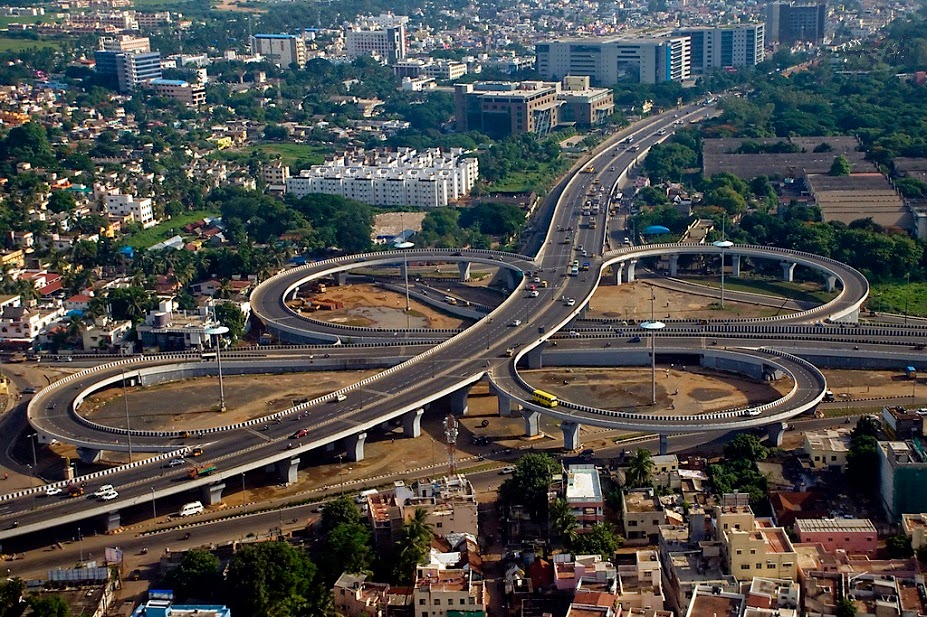
It is ‘South-Side Ho’ as far as Chennai real estate is concerned. Unprecedented one may call it, but the city is growing at a phenomenal pace, albeit unevenly. There is a clear north-south divide as southern localities have been growing at a faster rate with newer locations frequenting on the realty map almost every month, while north city has been left to fend for itself.

Shocking it may be, but some of the localities in North such as Madhavaram, Puzal, Tiruvottiur, Avadi, Manali or Meenjur, which are within Chennai Corporation limits, do not even have basic facilities like tar roads, sewage and drinking water connection and streetlights, leave alone other amenities like parks and recreational facilities that their southern counterparts are endowed with.

The alleged step-motherly treatment to northern localities has indeed affected the real estate growth and investors and realtors seldom look for investing or launching new projects there, due to locational disadvantages coupled with poor infrastructure and lukewarm demand. 

 Static growth

According to a recent report, almost 90 per cent of the projects are presently concentrated on South and North Chennai localities, with more than 60 per cent of them are under various stages of development in peripheral areas.

“I bought a flat in Thiruvottiur four years back for Rs 15 lakh and when I tried to book profit, I was quoted somewhere around Rs 17 lakh citing ‘not much growth’ and lack of basic facilities. Had I invested this money in a property at any of the southern Chennai localities somewhere on GST Road, OMR, or even in Sriperumbudur, which is one the fast growing areas in Western corridor, I could have got atleast 40-50 per cent appreciation in capital value,” rued Sadagopan, a realty investor from Ambattur, who is now planning to shift his focus to OMR, ECR or GST Road locations.

N Nandakumar, CREDAI
Denying that there is any such divide, N Nandakumar, Managing Director, Devinarayan Housing and Property Developments, said, “As North Chennai developed to an industry-centric area much before South, the dominance of blue-collared community had paved way for the growth of residential, basic and social infrastructure to suit people’s necessities and affluence. However, unfortunately, one may call it, the presence of industries has failed to transform, modernise or upgrade North Chennai to a formidable region as the focus of development of the city had shifted to South and its peripherals areas for various reasons.”

 Key drivers of South

Explaining that the disparity in realty development between north and South was due to the key drivers the latter was enjoying such as employment, physical infrastructure, connectivity to important locations, access to social infrastructure, planned development, proximity to premium office spaces, accessibility to southern districts and vast land availability, WS Habib, Managing Director, Ramky Wavoo Developers and Treasurer of CREDAI Chennai, said, the IT/ITeS, manufacturing and automobile sectors are going to be the major driving force for overall growth in Chennai.

WS Habib
Over the next five years, 21 million sq ft of additional office space will be absorbed in Chennai with southern areas alone accounting for 18 million sq ft. This would further trigger the housing demand in this part of city, he explained.

Agreeing that IT boom has made all the difference for South Chennai, Nandakumar, who is also the Chairman of CREDAI, Tamil Nadu, said, “Dominated by white-collar segments’ affluence and IT boom, South Chennai has seen phenomenal development in tandem with the urban agglomeration. Having said so, in recent times, North Chennai too has started attracting developers as large land parcels are being transformed into residential and related social infrastructure development.” However, north has a long way to go to catch up with south, feel realty experts.

Change in sight

Arguing that physical and social infrastructure in North Chennai did not keep pace with growth in South Chennai leading to a widening of gap in preference of South over North among homebuyers, Sanjay Chugh, Head of Chennai, Residential Services, Jones Lang LaSalle (JLL) India, a leading real estate research firm, said,North Chennai was the first commercial hub and home to traders and wholesalers who had established their business right from the British era. The area around the commercial hub also gradually developed residentially due the captive demand from the community that had their business interest in North Chennai. However, post 1960’s there was a gradual move towards Central and South Chennai and these areas witnessed development of social and physical infrastructure. With the IT boom in the 90’s there was a quantum jump in demand for commercial, residential and retail space in the Southern parts of the city and property prices saw a healthy appreciation.”

Sanjay Chugh, JLL
However, the gap between the North and South areas of Chennai is showing some reduction, thanks to the shifting of focus of some of the leading builders towards several areas of North and North West Chennai for the last 2-3 years.

Sanjay added, “Over the last few years prominent developers from Chennai like Prince Foundations, VGN, Arihant, TVH, Landmark, Chaitanya, Ganga Foundations and Navin’s have ventured into North Chennai in a bid to create quality living spaces. Metro Rail connectivity to North Chennai is expected to further stimulate growth prospects.”

Blaming the mindset and overall poor infrastructure for its current status, Habib said, ‘Even after several years, people still reminisce rickety buses, narrow by-lanes, overflowing sewers and mechanics and hawkers doing business on footpaths in north Chennai. Much of North Chennai is industrial land and has traditionally been the hub for industrial and warehousing facilities due to its proximity to the port. The residents are largely from labour and fishing communities. The purchasing power of these people is comparatively very less for a premium development.”

The traditional perception of north Chennai having high crime rates is also hitting the realty development, he pointed out.

On the other hand, South Chennai with its proximity to the IT parks is seeing high development due to employment opportunity, which drives the overall growth of the real estate sector here. “However, in the recent times, the purchasing power of lower and middle income groups in North Chennai has increased manifold. The second and third generations to those who worked in railways, industries here are moving up in the economic ladder. The increased purchasing power is changing the skyline with a number of large-scale properties setting up base there,” he reasoned.

About having even growth throughout the city, Habib added, “If IT zones and other industrial zones are notified in various parts of the city, rather than in one particular location, development would be evenly distributed.”

 Perceptions matter

Pitching his view on the uneven development in Chennai, Dr R Kumar, MD of Navin Housing and properties, said, “Actually, it is the chicken and egg question, and we cannot say that it is because of Governments’ intervention/inaction or it is because of the elite's preference, but the fact is, the combination of these two factors virtually created north-south divide. You can see parallels in the Hoogly and Calcutta divide as also the old Delhi and New Delhi divide, where it is more pronounced.”

Dr R Kumar, Navin Housing
“In addition, I also think there is a certain amount of cultural difference, in perceptions and in lifestyle, between North and south Chennai. I think, we have a responsibility to change these perceptions and lifestyle differences by physical intervention, by developing well-planned townships in North as well. At Navin's we are trying to do our bit by developing a integrated project, with all modern amenities, a project, which even South Chennai would be proud of!,” he added.

Price factor

Irony one would say, the distance from Chennai Central Railway Station to IT hub Siruseri on OMR and Katankulathur on GST Road is around 35 km and 43 km, respectively, while, the distance between the Central to Thiruvottiur and Manali is about 11 km. However, the real estate prices in the south locations are far higher than the two mentioned northern localities. While one could purchase a home for about Rs 2000 to 2500 per sq ft in Thiruvottiur and Manali areas, the price is more than double in areas near Siruseri and Katankulathur. However, people who buy a home in some of the northern Chennai localities have to face problems due to lack of sewage and water connection, frequent power outage, darker streets, uneven roads and lack of shopping facility. This tells the ambiguity of real estate development in Chennai.

Since the transport connectivity is awfully inadequate, people from northern localities are finding it difficult to travel to their work place situated in south and other areas.

Though North Chennai areas are being consistently ignored and overlooked for many years, there is hardly any move from the government’s side to develop these localities at par with their southern counterparts. To break the ice, a few builders have recently launched residential projects in and around Ambattur (which is well connected to fledgling Annanagar), however, not many projects are in the offing to trigger realty growth there.  Sad, one may call it.